An organza ribbon sample request should distinguish the offer of a physical sample from its declared form and representation. First ask whether the supplier actually offers a sample for the confirmed ribbon reference. Only then ask whether the declared deliverable is a named complete roll, an identified loose strip or another supplier-described form. Neither the catalogue roll presentation nor the word “sample” supplies that answer.
Start with confirmed product references
Use the official Satin Edge Organza Ribbon page to identify the catalogue product behind the enquiry. Retain the supplier-confirmed width, colour and version references that are actually available. These references identify the proposed sample’s subject; they do not establish sample availability, a supplied length or coverage of every configuration. Leave proposed but unconfirmed references outside the confirmed representation record.
https://ehribbon.com/product/satin-edge-organza-ribbon/
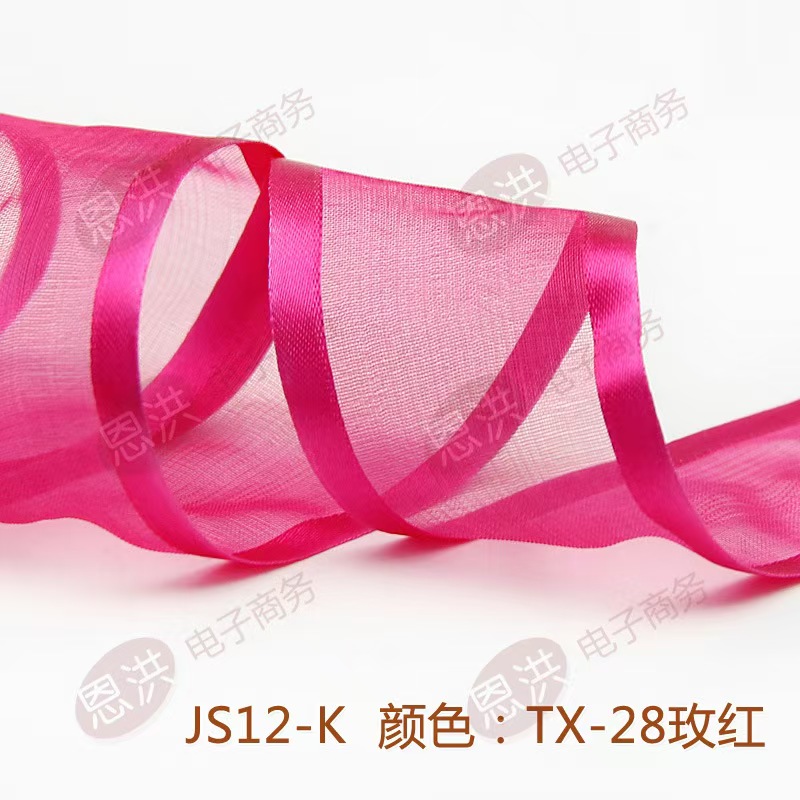
The catalogue name is an attributed product label, not independent proof of composition or decorative performance. Likewise, a photograph identifies a presentation without declaring what a future sample would contain. Ask the supplier for its own deliverable description for the exact confirmed references. Keep that response distinct from earlier comparisons of edge photographs or commercial discussions about a quoted production roll.
Confirm the offer before the form
Record whether a physical sample is expressly offered. “Sample not offered,” “offer not stated” and “form not declared” describe different gaps. The first concerns an actual negative reply, the second a missing offer statement, and the third a missing description after an offer has been discussed. Retaining these distinctions prevents a tentative request from appearing as an agreed sample arrangement.
If a sample is offered, ask the supplier to name its form. Preserve “complete roll,” “loose strip,” “piece” or another description only when expressly supplied. Do not substitute a familiar form because the catalogue photograph shows a roll. A record can identify an offered physical sample while keeping its roll-or-loose-piece scope unresolved until the supplier clarifies it.
Do not add unstated deliverable details
A form description does not supply length, width, piece count or packaging details. Keep those fields unfilled where they have not been declared rather than treating the form name as a quantity specification. The current purchasing decision identifies what form the supplier says it offers and which reference it represents. It does not create a sample service or a promise of particular contents.
For example, a reply may identify a loose sample piece and cite a confirmed colour reference while leaving its relationship to the named edge configuration unanswered. Record the stated form and colour relationship, then keep edge representation unconfirmed. Do not describe it as representing the complete edge configuration merely because the original product page uses the Satin Edge Organza Ribbon name.
Ask what the sample represents
Request the supplier’s stated relationship between the offered sample and the exact product version, width reference, colour reference and edge configuration being discussed. Treat each relationship as a separate correspondence field. A declared match to one reference does not establish coverage of the others. The record should distinguish the supplier’s explicit representation from the buyer’s wider intended comparison.
If the supplier identifies a particular sample reference, retain it with the reply or document revision. If it does not, keep that attribution gap visible. An existing photograph or an earlier edge-sample discussion should not be relabelled as the current physical deliverable. Request the relationship to the new offer without assuming that earlier sample evidence covers the present configuration.
Build the form-and-representation record
The following structure separates offer status, physical form and representation. Populate it only with actual supplier statements or a named open status. It does not assume a sample, a complete roll, a loose piece or any specific configuration is available.
| Record field | Supplier information to retain | Status when unresolved |
| — | — | — |
| Product references | Confirmed version, width and colour references | Reference not confirmed |
| Physical sample | Express offer statement and source | Not offered or not stated |
| Deliverable form | Supplier’s literal roll, strip, piece or other description | Form not declared |
| Representation | Explicit product and edge-configuration relationships | Applicability unconfirmed |
| Sample reference | Attributable identifier or reply revision | Reference not supplied |
| Open question | Specific missing form or representation detail | Awaiting clarification |
Keep partial replies useful without overstating them. A supplier can clarify form while leaving representation unresolved, or identify a represented version without declaring the deliverable form. Preserve both outcomes in the record. A single status such as “sample confirmed” would conceal the distinction and could lead another purchasing colleague to assume that all requested references were addressed.
Control the scope of later changes
If a proposed width, colour or product version changes, ask whether the existing sample statement still applies. Keep the earlier reply connected to its original references until that relationship is supplied. An unchanged catalogue product family does not establish that a sample offered for one configuration represents a revised proposal or a different confirmed order row.
The supplier’s representation statement also does not establish bulk-order acceptance, material authenticity, suitability or performance. It identifies only what the supplier says the offered sample represents. Preserve that limited purpose when summarising the reply. Do not turn an applicable sample reference into a conclusion about an entire production lot or the availability of further samples and services.
Frequently asked questions
Does the roll photograph mean the physical sample will be a roll?
No. The catalogue presentation identifies the product being discussed. Ask the supplier whether a physical sample is offered and request its declared form. Keep complete-roll or loose-piece scope open where the supplier has not identified it.
Does “loose strip” provide a supplied length or piece count?
Retain it only as the form expressly described. It does not supply unstated quantities or dimensions. The buyer record should preserve the literal description without adding contents from convention or from another sample discussion.
Can one confirmed colour relationship establish complete configuration coverage?
Keep the relationships separate. A statement identifying a colour reference does not automatically identify the represented width, product version or edge configuration. Ask about the unresolved references and retain their individual statuses until clarified.
What should remain open after an incomplete sample reply?
Preserve any missing offer statement, undeclared form, unidentified sample reference or unconfirmed representation. An attributable clarification can close a particular correspondence gap without establishing sample-service availability, complete-order acceptance or product performance. Keep the scope of the reply explicit.
Send the confirmed ribbon references with the offer, form and representation questions separated. If an actual sample statement already exists, identify which relationships still need the supplier’s clarification.
https://ehribbon.com/contact/
Retain the reply with the applicable proposal revision. The company’s article index can support related purchasing records while sample correspondence stays tied to its own supplier evidence.
https://ehribbon.com/blog/