
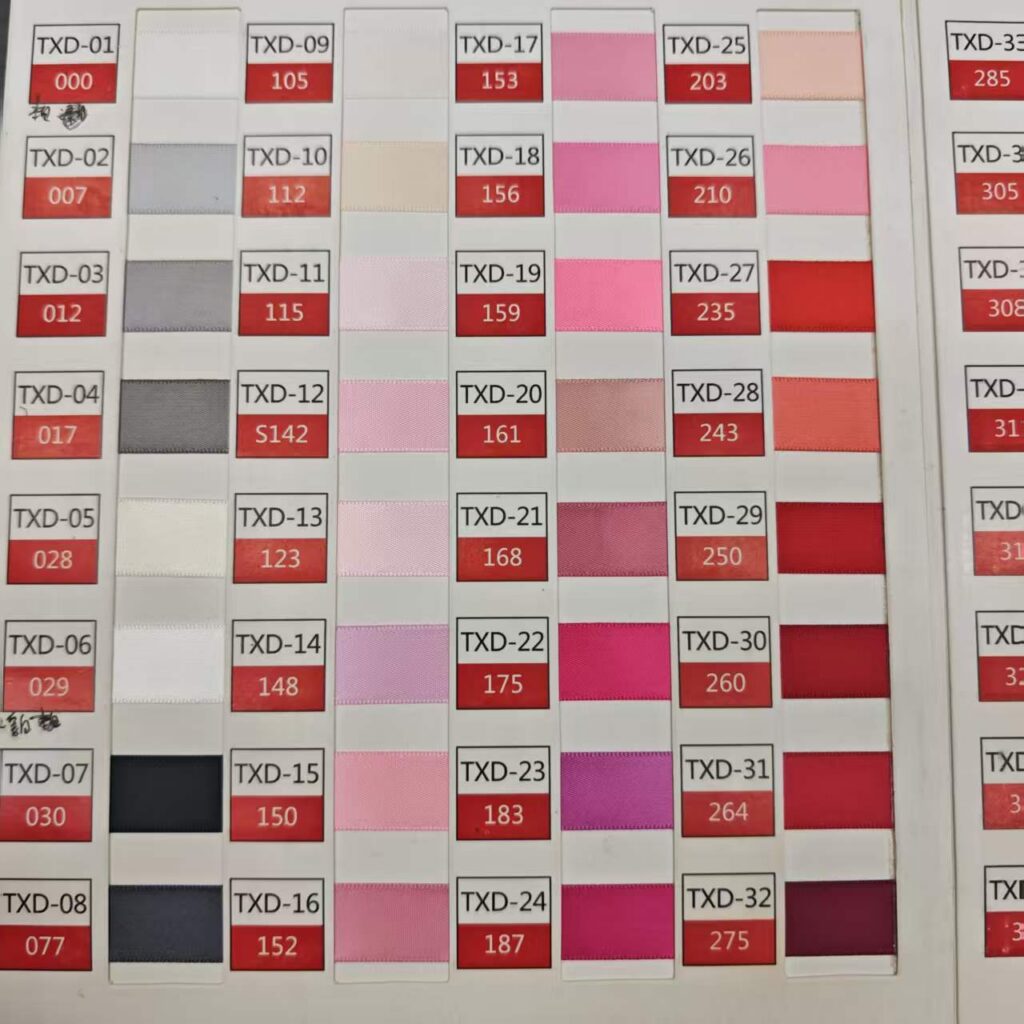
Map a polyester-ribbon shade by preserving the supplier’s literal name or code and linking it to the exact reference offered for review. Keep a buyer’s internal shade name separate until the relationship is confirmed. A ribbon photograph can identify a catalogue product without establishing a calibrated colour, a current stock option or equivalence between production lots. The buying record should show which reference supports the proposed shade and which parts of the request remain unanswered.
Start with the named ribbon and its limited evidence
Ehribbon’s historical official page names Polyester Ribbon. The separate catalogue reference used here shows ribbon swatches arranged in a physical sample book with printed labels. Those descriptions locate the reference image; they do not establish the supplier’s actual shade codes or verify the fibre content implied by the product name. Use the page as the product identity, then ask the supplier which exact offered reference its colour statement covers.
A buyer may describe a shade with a retail collection name, while a supplier uses a catalogue number or a sample label. Neither vocabulary needs to replace the other. The problem begins when someone copies one term into the other party’s field and assumes an agreement exists. Preserve the two terms and record the supplier’s explanation of their relationship. If the relationship is not confirmed, make the open question visible beside the proposed order line.
Distinguish the available reference roles
A catalogue photograph, a supplier-identified swatch and a named physical roll can serve different purposes. Ask which role the supplier intends for each item it sends. A photograph may show the type of ribbon under discussion, while a later sample may be proposed for a specific shade decision. Do not infer the connection from apparent similarity. Keep any supplier statement about that connection attributed to its actual source.
If the supplier supplies only a code, ask what reference the code identifies. If it supplies only an image, ask which literal offer description belongs to it. Neither missing answer should be filled with an invented colour-system designation. A buyer can maintain a useful crosswalk while some fields remain unavailable. Completing every cell is less valuable than distinguishing an actual response from a purchasing team’s assumption.
Build a crosswalk with separate identity fields
Record field | Supplier information to request | Buyer information to retain
Product reference | Exact ribbon offer covered by the response | Relevant enquiry or order-line identity
Supplier shade | Literal name and code actually supplied | Preserve wording without silent substitution
Buyer shade | Relationship, if any, to the requested reference | Internal name kept separate from supplier code
Evidence reference | Named photo, sample or swatch actually identified | Record which item was received and reviewed
Decision and limit | Scope of the proposed shade statement | Approval, question or unavailable relationship
This crosswalk does not prescribe a colour tolerance, a matching process or a swatch service. It asks what the supplier can actually identify. If a physical reference has not been supplied, do not describe one as reviewed. If a photo contains several rolls, ask which roll the response concerns. A buyer’s annotation can help pose the question, but it is not a supplier confirmation until the supplier answers it.
Avoid turning catalogue appearance into an offer
The old photograph contains several apparent shades, but their presence in a catalogue does not establish a current assortment or availability. A request for one of them remains a request. Ask the supplier what it is offering for the exact enquiry and keep any unanswered commercial questions separate. Do not infer a minimum quantity, a delivery date or a custom matching capability from the number of rolls in the picture.
Likewise, one reference should not automatically be extended to every ribbon width, finish or packaging format. This article does not establish that such variants are available or equivalent. If the buyer’s proposed offer changes, ask whether the same shade reference still applies. Keep the supplier’s actual answer, including any limitation, rather than treating a shared colour name as proof of an unchanged physical article.
Keep shade identity separate from other ribbon decisions
Earlier purchasing questions may distinguish a visible ribbon face, reconcile rolls and length, or ask about joins. Those decisions do not identify a shade code. Link to the correct product reference when needed, but avoid copying their approval status into the colour record. Conversely, accepting a named shade reference does not approve uninterrupted length, splice treatment, material authenticity or a folded appearance.
The distinction matters when different colleagues handle an enquiry. One person may have accepted a quantity schedule while another is waiting for a shade response. A single generic “approved” status can hide that difference. A clear crosswalk records the specific decision and the evidence it covers, allowing the team to follow up on the unanswered shade question without implying that the entire order specification has been settled.
Preserve a usable revision trail
Consider two buyer order lines that use the same internal shade name but point to different supplier references. Keep both rows until the supplier explains whether it is offering one identified shade or two alternatives. Do not merge them because the pictures look similar. If a replacement reference arrives, record which row it replaces and which buyer decision needs reopening. This prevents a naming correction from quietly changing the colour reference for another order line.
The final record should be understandable without a remembered conversation. It identifies the ribbon offer, the supplier’s shade wording, the reviewed reference and unresolved limits. It does not prove colourfastness, dye consistency or performance. Where evidence is missing, an explicit pending field is more useful than a precise-looking code that nobody has confirmed for the proposed purchase.
Frequently asked questions
Can a colour code be assigned from the catalogue photograph?
Do not invent a code from appearance. Ask the supplier for its literal identifier and the reference that identifier covers. A buyer’s internal shade name may be useful, but it is a separate field until the relationship is confirmed.
Does the product name verify the material?
No. Polyester Ribbon is the supplier’s catalogue identification. This shade record does not independently verify fibre content or any associated performance. Keep those questions separate from the shade-reference crosswalk.
Does the photograph show all colours currently available?
It shows historical catalogue rolls. It does not establish present stock or an offered assortment. Ask what the supplier is actually proposing for the enquiry and retain any availability statement with its own scope.
Does approving one shade reference establish consistency across lots?
No. A decision identifies the reference reviewed for an offer. It does not establish a dye-lot relationship, a tolerance or a colourfastness result. Those subjects require separate evidence if relevant to the purchase.
Send the exact reference with the shade enquiry
Use the named ribbon page to identify the product and the contact channel to request the supplier’s shade wording and evidence reference. The blog can provide catalogue context, while the decision remains tied to the actual response and the item the buyer reviewed.
https://ehribbon.com/product/polyester-ribbon/
https://ehribbon.com/contact/
https://ehribbon.com/blog/