A flocked ribbon material statement should identify the exact offered version and the areas it covers. Ask the supplier to distinguish the base ribbon from any relevant decorative or edge areas and to provide an attributable statement for each applicable scope. Leave unknown details open. A catalogue term, seasonal motif or metallic-looking appearance cannot establish composition or an independent test result.
Use the catalogue name as a locator, not a composition result
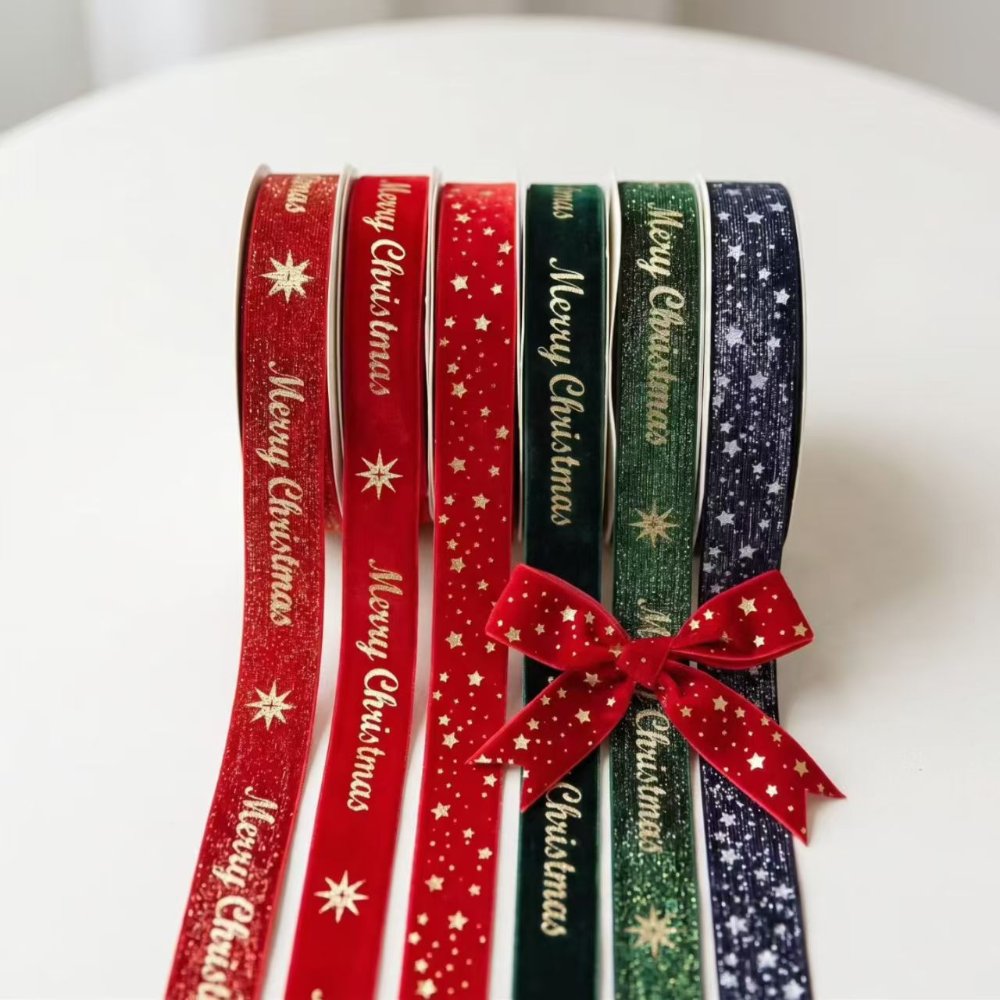
Enhong has an actual Flocked Ribbon product listing with a retained official photograph of decorated ribbon presentations. The image identifies the appearance being discussed. It does not reveal fibre percentages or establish a technical account of the surface treatment. Start the enquiry with that exact product reference and ask which version the supplier is offering.
Buyers of wholesale flocked ribbon may need a material description for purchasing records or product-copy preparation. The useful output is an attributable statement with defined coverage, rather than a generic description borrowed from another decorative family. Do not use a glitter, satin or polyester example to complete a missing material field for the selected flocked version.
Name the areas before asking what they contain
Ask the supplier to identify the base ribbon and any relevant decorative, edge or other material areas in its own specification. Use a marked picture or drawing to make the requested scope clear. A visible star or word can identify an area for a question without establishing how it is made. Do not invent a separate coating, adhesive or backing merely because one could be used in a similar product.
Retain both buyer and supplier terminology where they differ. For example, a supplier may group several areas under one declared material statement. Ask it to identify that coverage explicitly rather than assuming the entire product shares one composition. If an area cannot yet be mapped, mark it unresolved and request a product-specific explanation instead of filling it with a conventional material guess.
Build a coverage register with an original-source field
Keep the supplier’s original wording beside any summary prepared by purchasing. If the response gives only a broad descriptive term, preserve that limitation and ask what further detail is available. A blank percentage field is not an invitation to copy a common blend from another ribbon. The register should show the actual evidence gap rather than hide it behind a complete-looking form.
Register field | Supplier response requested | Evidence boundary
Product version | Exact flocked ribbon and offered reference | Not a different decorative family
Area covered | Marked base, decoration or relevant edge scope | No assumed internal layer or process
Material statement | Actual declared identity or composition | No inferred percentages, grades or metal content
Source document | Attributable file or written response and revision | Document existence does not prove applicability
Coverage status | Confirmed scope and unanswered areas | Declaration distinct from independent testing
Check applicability without turning a declaration into a certificate
Compare the named item and version in the statement with the offer being reviewed. Ask whether the declaration covers the requested colour or decorated version and retain any qualification. A broad supplier document may provide background while leaving a specific decorative area unanswered. Record what the supplier actually confirms about that relationship.
If a report or certificate is provided, review its applicability separately: the identified sample or material, covered property, source and limitations. Do not describe the product as independently tested or certified merely because an attached document exists. This article does not establish that any such report has been supplied for the selected Flocked Ribbon listing.
Carry only the confirmed scope into purchasing and copy
Link the material statement reference to the relevant order version and garment-independent ribbon area. Preserve the source wording and identify who approved any shortened purchasing description. A statement covering one named area must not become an unqualified whole-product composition claim after editing. Keep unanswered areas visible for the next responsible reviewer.
A material statement also does not establish shedding resistance, colourfastness, fraying behaviour or suitability for every decoration. The source photograph includes seasonal lettering and a bow presentation, but neither is a performance evaluation. Keep any requested handling or use-related claim with its own evidence requirement rather than allowing it to enter the material register as an assumed benefit.
Review the statement when the offered version changes
Send the area map through the current product enquiry or contact link below. A clear supplier response can support the next purchasing decision without inventing a formulation, a manufacturing process or a certification. It also prevents a visually attractive alternative from silently inheriting the selected product’s material record.
• Identify the exact flocked ribbon version and request the supplier’s actual material statement.
• Map each statement to the named area it covers and leave missing coverage unresolved.
• Keep declarations, independent tests and appearance observations accurately distinguished.
• Request renewed applicability confirmation for a relevant material, decoration or supplier version change.
Frequently asked questions
Does the name flocked establish the complete composition?
No. Use it to locate the catalogue product and request the actual material statement and its covered areas for the offered version.
Can a metallic-looking border prove metal content?
No. Appearance can identify an area to ask about. Material identity or content requires an applicable supplier statement or other evidence.
Is a declaration an independent laboratory result?
No. Retain the source and type of evidence actually received, and do not relabel a supplier statement as independent testing.
Can a different decorative ribbon share the same material record?
Only where the actual source explicitly covers that version. Otherwise keep a separate reference and unresolved scope rather than transferring a statement.
Product and contact references
https://ehribbon.com/product/flocked-ribbon/
https://ehribbon.com/product/gold-edge-satin-ribbon/
https://ehribbon.com/contact/
https://ehribbon.com/blog/